

TL;DR:
- Most retail forex traders fail due to poor risk management, not wrong market predictions.
- Pre-trade planning, including stop-loss placement and position sizing, is essential for consistency.
- Continuous review and discipline are key to adapting and improving risk strategies over time.
Most retail forex traders don’t lose money because they pick the wrong currency pairs. They lose because they fail to manage what happens when a trade goes against them. One undisciplined trade, where a stop-loss gets moved “just this once,” can erase two weeks of steady gains in a single session. 76% of retail forex traders consistently lose money, and the root cause is almost never a lack of market knowledge. It’s a lack of structured risk management. This guide covers the exact tools, sequences, and habits you need to protect your capital and build a track record that lasts.
Table of Contents
- Why risk management matters more than predictions
- What you need before placing any trade
- Step-by-step: How to manage risk like a pro
- Troubleshooting: Common mistakes and how to avoid them
- Verifying your process: How to evaluate and improve continuously
- Why conventional wisdom about forex risk management doesn’t go far enough
- Take your risk management to the next level with DayProp
- Frequently asked questions
Key Takeaways
| Point | Details |
|---|---|
| Discipline beats prediction | Sticking to risk rules is more important than calling market direction accurately. |
| Set stops before sizing | Always define your exit and loss tolerance before deciding your position size. |
| Adapt your risk tools | Use ATR-based stops and review your plan to avoid being outpaced by market shifts. |
| Review and refine | Track each trade and regularly adjust your methods for better, long-term results. |
Why risk management matters more than predictions
To understand why the following methods work, let’s first reorient our focus from just market calls to disciplined risk management.
Many traders spend the majority of their time studying chart patterns, economic calendars, and technical indicators. That’s not wrong, but it’s incomplete. The uncomfortable reality is that even a strategy with a 60% win rate can destroy an account if the losses on the 40% of losing trades are significantly larger than the wins.
Professional risk management is what separates traders who survive long enough to improve from those who blow their accounts within months. The data is clear: 76% of retail forex traders lose money over time, and the primary driver is unmanaged risk, not poor market analysis.
Consider what this means practically. A trader with a modest 50% win rate but a 2:1 reward-to-risk ratio will grow an account steadily over time. A trader with a 70% win rate but no stop-loss discipline, occasionally letting losses run to 5x or 10x the intended size, will eventually face a catastrophic drawdown. Discipline is the actual success factor for consistent profits, not prediction accuracy.
Key reasons risk management outweighs prediction:
- Losses compound faster than gains. A 50% drawdown requires a 100% return just to break even.
- No strategy wins every trade. Even institutional desks operate with defined loss limits.
- Emotional decisions scale with losses. The bigger the loss, the harder it is to trade rationally.
- Consistency requires rules. Without defined risk parameters, every trade becomes a new gamble.
“A disciplined trader with an average strategy will always outlast an undisciplined trader with a brilliant one. Risk management is the mechanism that keeps you in the game long enough for your edge to materialize.”
What you need before placing any trade
Now that we see why risk takes priority, let’s break down exactly what you must have in place before pressing “Buy” or “Sell.”
Pre-trade preparation is not optional. It’s the foundation of every professional trading operation. Before you execute any position, you need three things clearly defined: your stop-loss level, your maximum acceptable loss in dollar terms, and your position size calculated from those two figures. Skipping any one of these steps introduces unnecessary risk.

Stop-loss placement follows two primary methods. Structure-based stops are placed just beyond a meaningful support or resistance level on the chart. Volatility-based stops use the Average True Range (ATR), a technical indicator that measures how much a currency pair moves on average over a given period, typically set at 1.5 to 2 times the ATR. Both approaches are valid, but the key rule is identical: always define your stop before you calculate your position size. Your stop determines your risk per pip, and your risk per pip determines how many units you can trade.
Understanding risk parameters in trading also means setting a maximum daily loss limit. Many professional traders cap their daily loss at 2% to 3% of their account. Once that threshold is hit, trading stops for the day. This prevents the common spiral where a losing morning leads to revenge trading and a much larger afternoon loss.
| Pre-trade element | What it defines | Why it matters |
|---|---|---|
| Stop-loss level | Maximum pip loss per trade | Sets the boundary for the trade |
| Dollar risk per trade | Maximum capital at risk | Keeps losses proportional to account |
| Position size | Number of units to trade | Derived from stop and dollar risk |
| Daily loss limit | Maximum loss for the session | Prevents compounding losses |
Mental preparation is also part of this checklist. Before entering any trade, you should genuinely accept that the trade may lose. If you cannot accept that outcome before entry, you are not ready to trade that position. Traders who enter without this acceptance are the ones who move stops, add to losing positions, and make decisions based on hope rather than analysis.
Step-by-step: How to manage risk like a pro
With your pre-trade checklist ready, here’s how you can apply these tools in a simple, reliable sequence.
The sequence matters as much as the individual steps. Experienced traders follow a consistent order every time, which removes hesitation and emotional interference from the process.
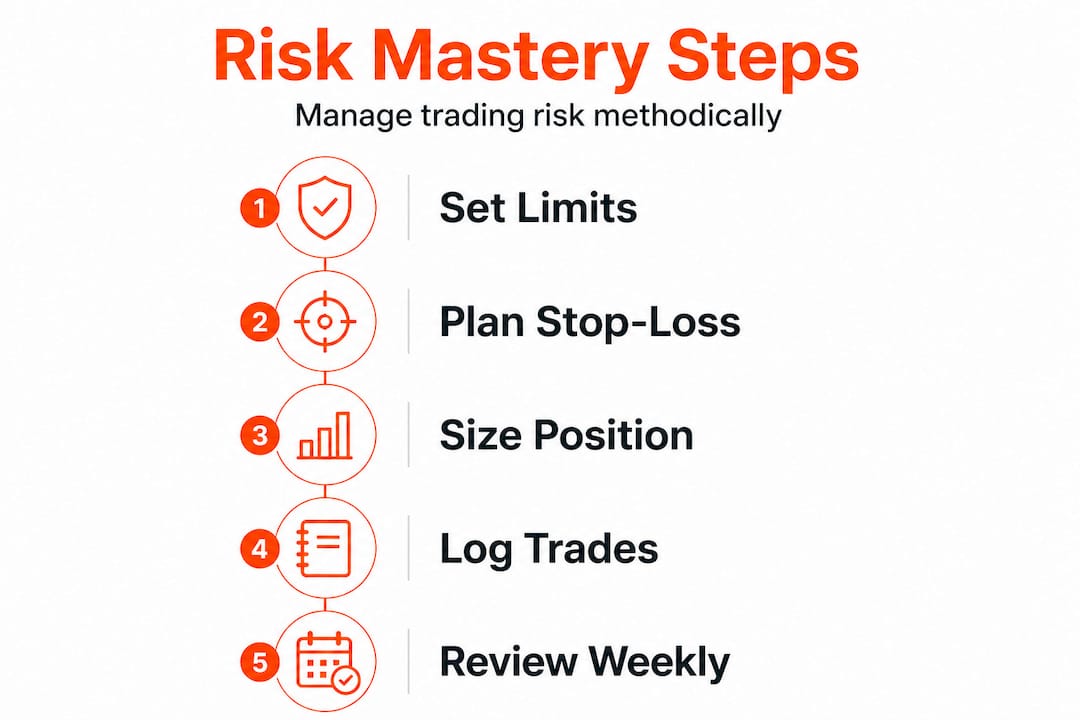
- Identify your trade setup. Confirm the technical or fundamental basis for the trade. Know why you are entering and what conditions would invalidate the setup.
- Set your stop-loss level first. Use structure-based or volatility-based stops to determine where the trade is definitively wrong. Place the stop beyond that level, not at an arbitrary round number.
- Define your dollar risk. Decide what percentage of your account you are willing to lose on this trade. For most traders, 1% to 2% per trade is the professional standard.
- Calculate position size. Divide your dollar risk by the pip distance to your stop, then adjust for the pip value of the pair you are trading. This gives you the exact position size that keeps your loss within your defined limit.
- Set a take-profit or trailing stop. Define your exit on the winning side before you enter. This prevents you from closing winners too early out of anxiety.
- Consider dynamic stop strategies. Adaptive risk management using ATR-based trailing stops allows your stop to move with market volatility rather than staying fixed. Fixed stops can be too tight in high-volatility conditions and too loose in low-volatility conditions.
- Log the trade immediately. Record your entry, stop, target, position size, and the reasoning behind the setup before the trade plays out.
Pro Tip: Use a simple spreadsheet or dedicated trading journal app to record every trade in real time. Waiting until the end of the day to log trades introduces memory bias and reduces the accuracy of your records.
| Stop type | Best market condition | Key advantage | Key limitation |
|---|---|---|---|
| Structure-based (fixed) | Trending or ranging markets | Clear, logical placement | Can be too wide or too narrow |
| Volatility-based (ATR) | Volatile or news-driven markets | Adapts to current conditions | Requires recalculation as ATR changes |
| Trailing stop | Strong trending conditions | Locks in profits automatically | Can exit prematurely on pullbacks |
Following steps for managing risk in this sequence removes the two biggest sources of trading error: impulsive position sizing and stop-loss levels set after the fact. Understanding maximum loss before you enter is what keeps a bad trade from becoming a bad month.
Troubleshooting: Common mistakes and how to avoid them
Great execution still requires maintenance. Here’s how to keep from sabotaging your own risk plan.
Even traders who understand risk management theory often undermine themselves in practice. The gap between knowing what to do and actually doing it under pressure is where most retail accounts are damaged.
The most destructive habit is moving or deleting a stop-loss after a trade moves against you. This behavior is almost always rationalized in the moment. “The trade is still valid, I just need more room.” In reality, moving a stop is a sign that the original plan was not fully committed to. It converts a controlled loss into an uncontrolled one. Stop-losses exist precisely for the moments when you don’t want to use them.
Ignoring volatility is the second major error. A stop placed 20 pips from entry might be perfectly reasonable on a quiet Tuesday but will be triggered by normal noise during a high-impact news release. Fixed stops fail in volatile conditions, while ATR-adaptive stops preserve your edge across different market regimes by adjusting to actual price movement.
Common risk management mistakes to avoid:
- Moving stops to avoid a loss. This is the single most account-damaging habit in retail trading.
- Sizing positions based on conviction, not rules. Trading larger because you “feel good” about a setup violates the entire framework.
- Measuring success only by win rate. A high win rate with poor reward-to-risk ratios produces losing accounts.
- Skipping the trade log. Without records, you cannot identify patterns in your mistakes.
- Ignoring correlated pairs. Holding multiple positions in highly correlated pairs multiplies your actual risk exposure beyond what your per-trade rules suggest.
“The traders who last in this business are not the ones with the best entries. They are the ones who never let a single trade define their account.”
Pro Tip: After any trade where you deviated from your plan, write a one-paragraph explanation of why. Reviewing these notes monthly will reveal your specific behavioral patterns faster than any other method.
Following best practices for trading means treating your risk plan as non-negotiable. Trading discipline is not about being rigid. It’s about building a system you can trust even when your emotions push back.
Verifying your process: How to evaluate and improve continuously
Mistakes are inevitable, but continual improvement will keep you ahead. Here’s how to measure real progress.
Risk management is not a one-time setup. It’s an ongoing practice that requires regular review and adjustment. Traders who treat their risk framework as static will find that it stops working as market conditions evolve.
The foundation of continuous improvement is a detailed trade journal. Every entry should record the date, pair, direction, entry price, stop-loss level, target, position size, actual exit, and the reasoning behind the trade. This is not paperwork. It’s the data set you need to identify what is actually working and what isn’t.
Always setting your stop-loss before position sizing is a rule that your journal will help you verify. If you review your records and find trades where the stop was adjusted after entry or where position size didn’t match your risk rules, those are the trades to analyze in depth.
Key metrics to track in your journal:
- Win/loss ratio. How many trades win versus lose over a meaningful sample size (at least 50 trades).
- Average win vs. average loss. Are your winners actually larger than your losers on average?
- Maximum consecutive losses. How many losing trades in a row did your system produce? Does your account survive that sequence?
- Deviation from plan. How often did you move a stop, skip a trade, or size incorrectly?
- Performance by session. Are you performing better during the London session versus New York? Data will tell you.
Review your journal weekly, not monthly. Weekly reviews keep the feedback loop tight enough to catch developing problems before they compound. Monthly reviews are useful for bigger picture analysis, but weekly check-ins are where real trading discipline is built.
Adjust your methods based on changing conditions. If ATR on your primary pairs has doubled due to macro uncertainty, your position sizes should decrease proportionally. If you are in a drawdown period, reduce risk per trade until your edge reasserts itself. The framework adapts. The core rules do not.
Why conventional wisdom about forex risk management doesn’t go far enough
Most retail trading education covers the basics of stop-losses and position sizing, then moves on. That’s where the gap opens between traders who improve and traders who plateau.
The standard advice is technically correct but practically incomplete. Telling a trader to “risk 1% per trade and use a stop-loss” is accurate. But it doesn’t address what happens when that trader faces five consecutive losses and starts questioning whether the rules even work. It doesn’t address how to adapt position sizing when volatility doubles. It doesn’t explain that the goal isn’t to find better setups. It’s to build a process you can execute without hesitation under pressure.
Experienced traders understand that longevity comes from consistency, not from streaky wins. A month with 12 solid, rule-compliant trades that produce modest gains is more valuable than a month with two massive wins and three account-threatening losses. The former builds a track record. The latter builds anxiety.
The deeper truth is that adapting your risk framework is more valuable than finding the perfect entry. Markets change. Volatility regimes shift. Correlations break down. A trader who is rigidly attached to one setup will eventually find that the market has moved past it. A trader who has built a flexible, rules-based risk process will adjust and continue. Focusing on factors for consistent profits means prioritizing process over outcome every single time, even when the outcome is a loss.
The most underrated skill in forex trading is the ability to take a planned loss without emotional consequence and immediately move to the next trade with full discipline intact. That skill is not taught in most trading courses. It’s built through deliberate practice, honest journaling, and a genuine commitment to process over results.
Take your risk management to the next level with DayProp
Once you appreciate what true risk discipline looks like, the next step is turning these principles into consistent habits within a structured environment designed for serious traders.
DayProp provides structured trading challenges that put your risk management skills to the test under real-world conditions. Our evaluations are built around professional risk parameters in trading, so you’re not just practicing theory. You’re building a verifiable track record. Whether you’re working through your first trading evaluation or exploring the full range of trading challenges available to retail traders, DayProp gives you the framework to demonstrate your edge and access institutional-level capital without putting your own funds at risk.
Frequently asked questions
How should I set my stop-loss in forex trading?
Use structure-based stops placed just beyond key support or resistance levels, or volatility-based stops set at 1.5 to 2 times the ATR, and always define your stop before calculating your position size.
What is the biggest mistake traders make with risk management?
Moving or removing stop-losses after a trade moves against you is the most damaging habit, as it converts controlled, planned losses into uncontrolled drawdowns that can seriously damage an account. The 76% retail loss rate reflects how often undisciplined risk behavior overrides even sound market analysis.
Are adaptive or fixed stop-losses better?
ATR-adaptive stops outperform fixed stops in changing volatility conditions because they adjust to actual market movement rather than remaining at an arbitrary distance from entry.
How much should I risk per trade in forex?
Most professional traders limit risk to 1% to 2% of their total account per trade, which prevents any single loss from creating a drawdown that’s difficult to recover from.
How often should I review my risk management process?
Weekly reviews of your trade journal are the most effective frequency for catching errors early and refining your approach before small issues become larger patterns.
Recommended
- How to manage risk in trading for consistent profits 2026 – DayProp Funding
- Demystify risk parameters in trading for consistent success – DayProp Funding
- Why traders need professional risk management in 2026 – DayProp Funding
- Essential professional trading rules to boost discipline – DayProp Funding
- Risk analytics step by step: A practical guide for financial institutions | RiskInMind